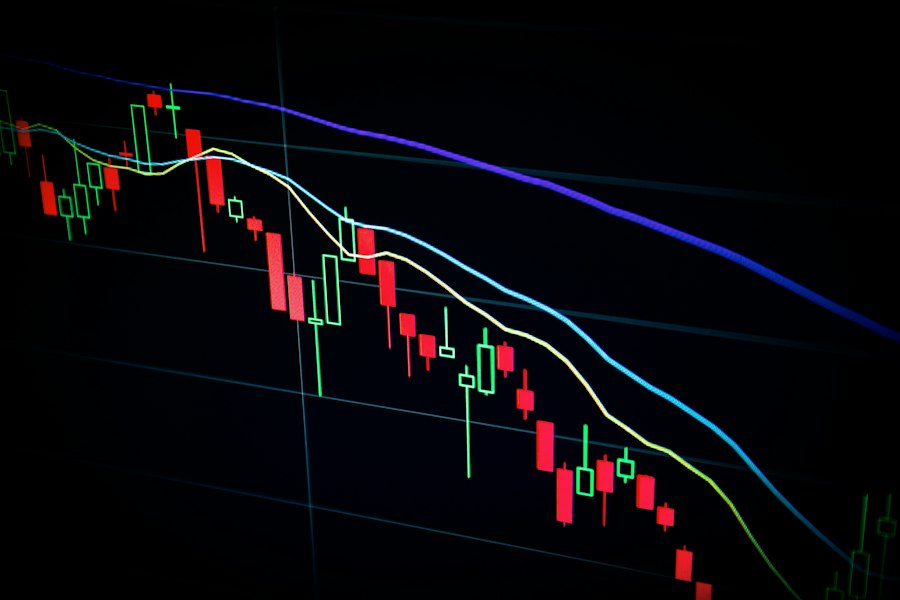

Your procurement model was built in January. It assumed a tariff rate. That rate has since changed — several times. Companies that anchored their annual plans to a number are now managing a distribution they never modelled.
This is not a temporary disruption. It is a structural feature of the current environment. And it exposes a failure of method, not just of forecasting.
The problem is not the tariff rate. It is the shape of the uncertainty.
Kyle Handley, Professor of Economics at UC San Diego and one of the world's leading researchers on trade uncertainty, made a distinction in February 2026 that every risk manager should read carefully. Firms, he argued, face two separate problems simultaneously. The first is risk: how large could the tariff impact actually be? The second is volatility: how often does the policy change, and what is the probability it changes again?
Most financial models handle the first problem badly and ignore the second entirely.
"Firms react to volatility — what's the probability the tariff changes next week? And they also react to risk — is it going to be 25% or 50%? The bigger the threats, the more caution they induce."
— Kyle Handley, UC San Diego, February 2026That interaction is the point. A 25% tariff that is permanent is manageable. You reprice, restructure your supply chain, renegotiate contracts. A tariff environment where the rate could be 10%, 15%, or 25% depending on a court ruling or a political announcement — that is something fundamentally different. The rational response, as Handley observed, is often paralysis.
"The best response for a lot of businesses right now is to do nothing, because there's so much uncertainty about what comes next."
Paralysis is not a business strategy. But it is a predictable output when organisations mistake a distribution for a point.
What a static model does — and what it misses
The typical response to tariff exposure is to update the procurement model. Change the assumed rate. Rerun the margins. Present the revised numbers to the board.
This is analytically coherent if the tariff rate is known and stable. It is not coherent when the tariff rate is itself a random variable with a distribution that shifts every few weeks.
The European exporter with a static model
A European manufacturer exporting to the US builds its annual plan around a 15% effective tariff — a reasonable central estimate. The model shows margin compression of four percentage points on US revenue. The CFO approves a hedging strategy calibrated to that number.
What the model does not show: the probability the rate drops sharply, the probability it rises above 20%, or the correlation between tariff changes and the exchange rate movements that accompany them. Each path produces a different financial outcome. A static model produces one. The business operates across all of them simultaneously.
This is not a modelling refinement. It is a category error.
The question is not "what is our margin at 15%?" The question is "what is the distribution of our margin across the plausible range of policy outcomes — and at what point in that distribution does the business become strategically unviable?"
Building a model that matches the actual problem
A probabilistic model of tariff exposure starts by accepting that the tariff rate is an input variable, not an assumption. It has a range, a most likely value, and a shape. That shape is not symmetric. The downside tail is fatter than the upside, because the political incentive structure is asymmetric. A triangular distribution captures the range. A scenario-weighted approach captures specific policy pathways and their relative likelihood.
The model then traces the tariff rate through its consequences. For an exporter, the chain runs: tariff rate → effective cost increase on US-bound goods → margin on US revenue → decision to absorb, pass through, or redirect volume → impact on fixed cost recovery if volume moves elsewhere. Each step is uncertain. Pass-through depends on contract terms and competitive dynamics. Volume redirection depends on alternative market availability — which is correlated with the same events driving the tariff change in the first place.
Monte Carlo simulation runs that model ten thousand times, drawing from each distribution on each iteration. The output is not a number. It is a distribution of margin outcomes — with a P10, a P50 and a P90. The P10 shows you what the business looks like in a bad year that is still within the plausible range. The shape between P10 and P90 tells you where the real exposure sits.
The tornado chart then answers the question that static models cannot answer at all: which variable is actually driving the uncertainty? The variables at the top of that chart are the ones that deserve the most attention — and they are rarely the ones the business has been managing most carefully.
Scenarios are not optional
Simulation gives you the distribution under a central assumption. Scenario analysis stress-tests the extremes. These are not the same exercise, and organisations that run only one are working with half a picture.
The scenario that matters most is not the one that feels most plausible. It is the one that would be most consequential if it materialised. For most exporters with significant US revenue, that is not a moderate tariff increase — most businesses have stress-tested that by now. It is a sharp, rapid escalation combined with a demand shock, hitting simultaneously at a moment when the supply chain cannot flex quickly enough to respond.
Handley's research offers a useful reframe for how to build the scenario set. He distinguishes between the direct cost of a tariff and the credibility cost of the environment it creates.
"It took 75 years to build up those commitments and that predictability. Even in a few years, we can't simply go back to the policy stability we had before."
— Kyle Handley, UC San Diego, February 2026That observation should change how finance teams think about scenarios. These are not temporary shocks from which the system reverts to a previous baseline. They are regime shifts. A model calibrated to the trade environment of three years ago is not a conservative model with updated assumptions. It is the wrong model for the world that now exists.
Calibrating uncertainty: the discipline most organisations skip
Building the model is the first step. Calibrating the distributions is harder, and it is where most organisations underinvest.
The tariff rate distribution should not be invented at a workshop. It should be anchored to observable evidence: historical frequency of policy reversals in comparable environments, the range of stated positions from credible institutional sources, the contractual constraints that set hard floors and ceilings on exposure. That is uncertainty calibration — assigning probabilities based on evidence, not intuition.
The same discipline applies to margin pass-through and volume assumptions. Customer contracts contain pricing clauses. Historical data on price elasticity in the relevant product categories exists. Competitor cost structures are partially observable through public filings. None of this eliminates uncertainty. All of it narrows the distribution to the range the evidence supports — rather than the range that feels comfortable to present to a board.
What organisations can do
The scenario analysis points to three categories of response. The simulation tells you which ones are worth funding.
Supply chain restructuring, sourcing diversification, changes in route to market. Expensive and slow. The model quantifies whether the cost of the restructure is justified by the reduction in tail risk — a trade-off that intuition alone cannot make.
Pricing clauses that allow pass-through above a defined threshold, volume flexibility provisions, explicit reference to trade policy changes as qualifying events. Cheaper than restructuring and often more effective. The model shows the P10 outcome with and without this protection.
The capability to redirect volume between markets quickly when conditions shift. The most valuable mitigation and the hardest to build — it requires spare capacity, multi-market approvals and distributor relationships that cannot be created after the event.
The model is not a one-time exercise
A probabilistic model of trade exposure is not a deliverable. It is a living instrument. The distributions need to be updated when the policy environment changes — and in the current environment that means reviewing key assumptions monthly, and immediately after any significant political or legal development.
That discipline requires someone to own the model, monitor relevant news systematically, and understand which inputs are sensitive enough to change the strategic output when their distribution shifts. The tornado chart identifies those inputs directly. The variables at the top warrant active monitoring. The ones at the bottom can be reviewed quarterly.
The organisations that will make better decisions over the next two years are not the ones with the most sophisticated models. They are the ones that treat the model as an active management tool — updated when the world changes, connected to pre-agreed trigger points that translate a shift in the distribution into a specific operational response.
Handley's conclusion on long-term credibility damage should be read as a modelling input, not just a geopolitical observation. "We can't just turn that back on." The uncertainty premium in trade exposure models should be structurally elevated — not calibrated to pre-2025 norms, and not expected to revert.
Build the model. Stress the tails. Update it when the news changes. Act on the ranges — before the next shift makes the decision for you.